
Monthly Archives: October 2026

Happy 800th Birthday into Heaven, St. Francis of Assisi

Guess the saint:

This saint joined a Crusade to Egypt in the hopes of PROSELYTIZING as many musloids as he could before being killed.  This saint was not killed, but was instead received into the court of a sultan.  Our saint then offered to engage in a trial by fire – literal fire – with the sultan’s musloid “scholars”.  Our saint offered to enter into a fire pit and if he emerged unscathed, the musloid scholars would then have to concede that the CATHOLIC GOD (the word “catholic” means “universal”, so of course God is Catholic, and of course His Church is Catholic) and not the phoney musloid god (our saint, like any intelligent person, knows that the thing called “allah” is a non-existent pagan-Bedouin moon deity concocted by the inventors of the musloid political system, inspired by satan himself) is the One, True God.  Naturally, knowing that their non-existent deity could not duplicate such a miracle, and not wanting to be burned to a crisp, the musloids declined the challenge – BUT the sultan granted our saint permission to PROSELYTIZE and win souls for Christ in his territory WHILE THIS VERY SULTAN WAS FIGHTING CRUSADERS.

Who was this saint who knew that not only was PROSELYTIZING not “solemn nonsense”, but was utterly essential and demanded by Our Lord – a direct corollary to the two Great Commandments, to love God and to love our neighbor?

Yep.  It was St. Francis of Assisi.
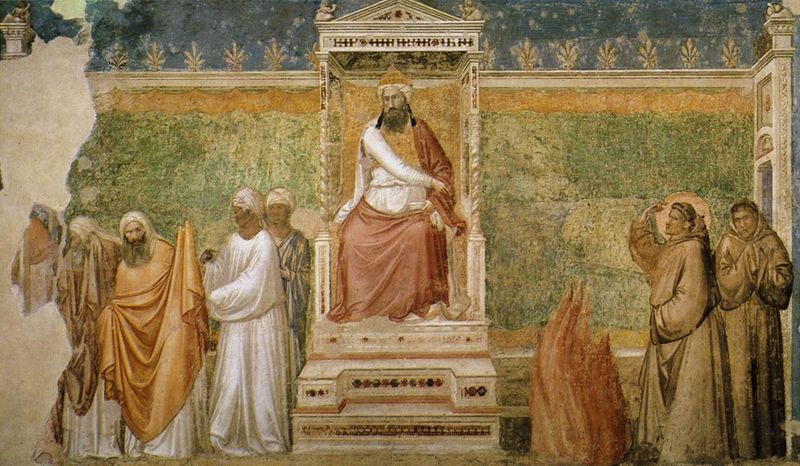
Giotto's fresco depicting St. Francis' Trial by Fire. The musloids are on the left, slinking away. Apparently this was all a terrible mistake on St. Francis' part. He should have merely Giotto’s fresco depicting St. Francis’ Trial by Fire. The musloids are on the left, slinking away. Apparently this was all a terrible mistake on St. Francis’ part. He should have merely “encountered” the musloids in a spirit of “dialogue” and “human fraternity”, and listened to their lies and then declared that they should all engage in good works and “meet each other there”. Because, you know, there isn’t a “Catholic God”, and the god the musloids believe in is the same as the Triune Godhead, or something. And God Himself being Goodness Itself, and good and evil being whatever the individual “conceives” them as being, “God” is whoever or whatever the individual says He, She or It is. Thank “god” we had Smart Antipope Fwancis and now his successor Antipope “FtR” PERVost today to correct all of the errors of Stupid Francis of Assisi.




Today is the Feast of YOUR Guardian Angel!

1angelawake004

For he hath given his angels charge over thee; to keep thee in all thy ways.
Quoniam angelis suis mandavit de te, ut custodiant te in omnibus viis tuis.

In their hands they shall bear thee up: lest thou dash thy foot against a stone.
In manibus portabunt te, ne forte offendas ad lapidem pedem tuum.
-Psalm 90: 11-12

I strongly suspect that we will all be mightily embarrassed when we are shown just how much our guardian angels have done for us, how many times they have saved our skins, how much they love us, and how little we acknowledged them. Make sure you acknowledge your guardian angel today, most especially.

St. Remigius: Shameless, Triumphalist Proselytizer. “Bow your gentle neck, Sigamber; adore what you have burned, burn what you have adored.”

“Sigamber” is a pejorative term akin to “barbarian”, referencing the Sicambrian race from which Clovis, King of the Franks, descended.

saintRemy
Saint Remigius baptizes Clovis I, by the Master of Saint Gilles, c. ARSH 1500 (National Gallery of Art, Washington, D.C.)
From CatholicTradition.org:

Clovis, king of all northern Gaul (France), was himself yet a pagan, though not unfriendly to the Church. He had married St. Clotildis, daughter of the Christian king of Burgundians, Chilperic, and she made repeated attempts to convert her husband. In 496, the Alemanni crossed the Rhine and the Franks marched out to drive them back. One account says that St. Clotildis had said to Clovis in taking leave, “My lord, to be victorious invoke the God of the Christians. If you call on Him with confidence, nothing can resist you”; and that the wary Clovis had promised that he would be a Christian if he were victorious. The battle was going badly against him when the king, either reminded of these words or moved by desperation, shouted to the heavens, “O Christ, Whom Clotildis invokes as Son of the Living God, I implore Thy help! I have called upon my gods, and they have no power. I therefore call on Thee. I believe in Thee! Deliver me from my enemies and I will be Baptized in Thy name!” The Franks rallied and turned the tide of battle; the Alemanni were overcome.

Queen St. Clotildis was not trusting to any enthusiasm of victory, and sent for St. Remigius, telling him to touch the heart of the king while he was well disposed. When Clovis saw her he cried out, “Clovis has vanquished the Alemanni and you have triumphed over Clovis. What you have so much at heart is done.” The queen answered, “To the God of hosts is the glory of both these triumphs due.” Clovis suggested that perhaps the people would not be willing to forsake their gods, but said he would speak to them according to the bishop’s instructions. He assembled the chiefs and warriors, but they prevented his speaking, and cried out, “We abjure mortal gods, and are ready to follow the immortal God whom Remigius preaches.” St. Remigius and St. Vedast therefore instructed and prepared them for Baptism. To strike the senses of barbarous people and impress their minds, Queen Clotildis took care that the streets from the palace to the church should be adorned with hangings, and that the church and baptistery should be lighted with a great number of candles and scented with incense. The catechumens marched in procession, carrying crosses, and singing the litany; St. Remigius conducted the king by the hand, followed by the queen and the people. At the font the bishop is said to have addressed Clovis in words that are memorable, if not actually pronounced: “Bow your gentle neck, Sigamber; adore what you have burned, burn what you have adored.” (Mitis depone colla, Sigamber; adora quod incendisti, incende quod adorasti.)” Words which may be emphatically addressed to every penitent, to express the change of heart and conduct that is required of him.

St. Remigius afterwards Baptized the king’s two sisters and three thousand men of his army, as well as women and children, with the help of the other bishops and priests present.

St. Remy, pray for us!

In the 6th century, Gregory of Tours reports that when Clovis I was baptised by Saint Remigius in 496 this bishop called Clovis a Sigamber, while referring to past barbarity:[30]