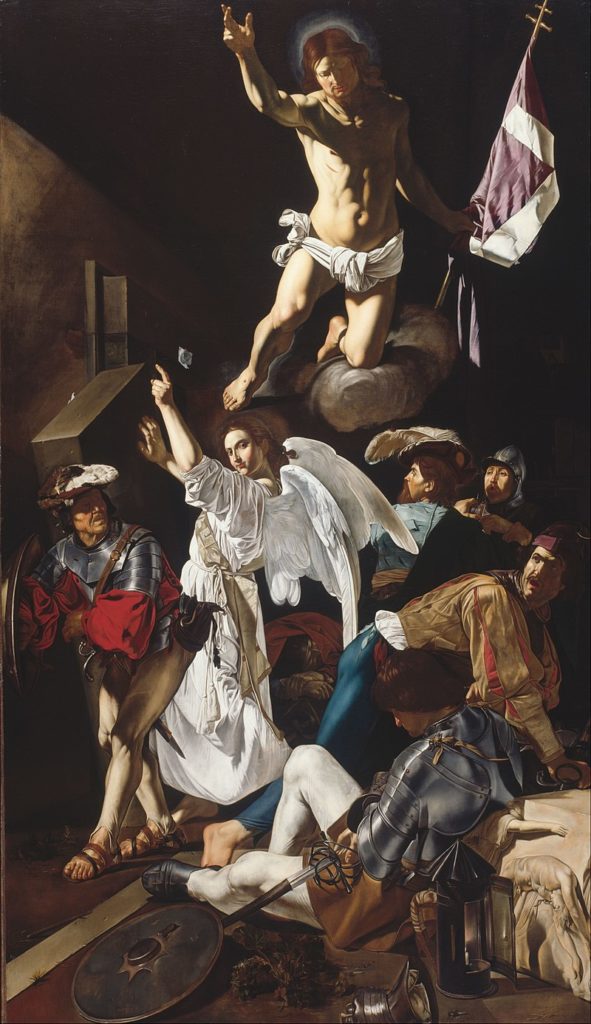
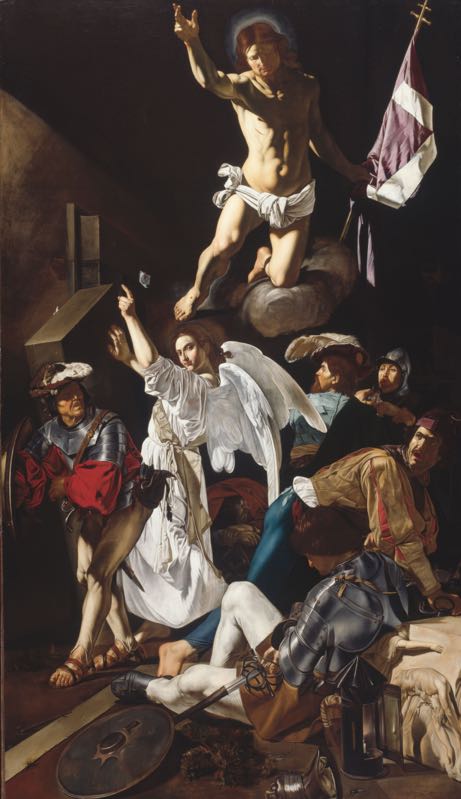
Look at the Angel. He just slays me with his eye contact. When you see this in person (it is in the Art Institute of Chicago), the effect is ten times stronger.
And now, as has become tradition, what has become quite possibly my single favorite piece of music ever, Bortniansky’s Cherubic Hymn Number Seven.
All we that in mystery Holy Cherubim portray As the life-creating Trinity With thrice-holy hymn we adore and praise. Come, let us cast off all earthly care And forget every vain employ.
For the King of All comes in triumph By unseen hosts of angels brought To us that bid Him welcome. Alleluia! Alleluia! Alleluia!
And a blessed, blessed Easter to all. Christ is truly risen! Alleluia!!!
Here is an Estonian choir performance:
And here is the SOVIET Academic Choir version. Yes, even the Soviets were insistent upon maintaining this choral tradition. Stop and think about that relative to our situation today.
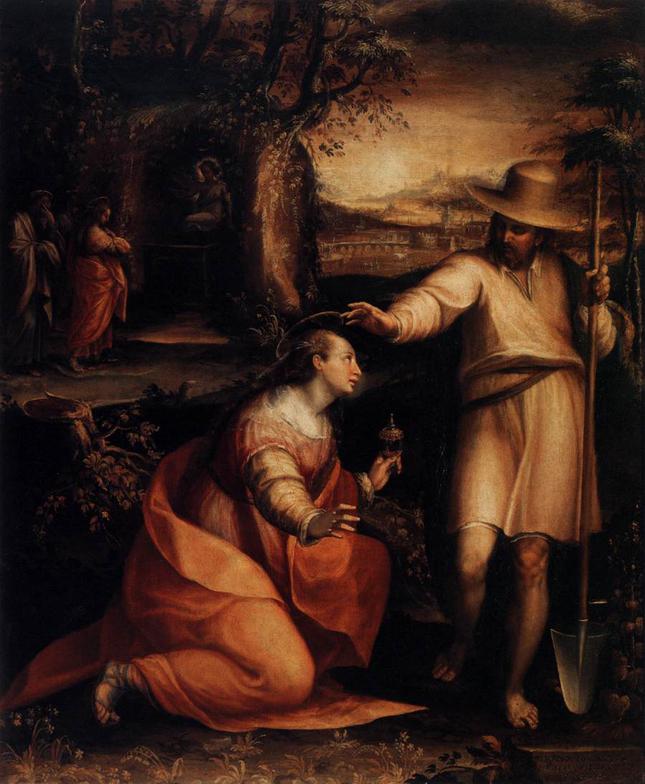
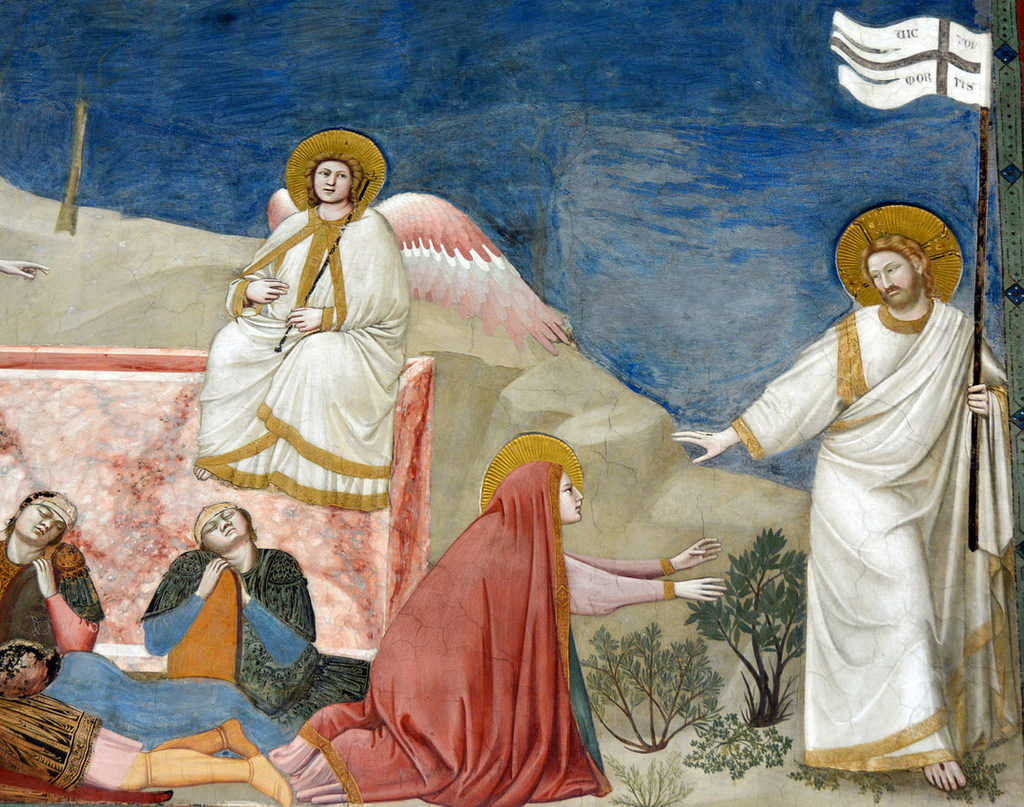
The beautiful painting above is of Mary Magdalene seeing Our Resurrected Lord in the garden close to the Empty Tomb and initially mistaking Him for the gardener. In art Our Lord is commonly depicted in this specific scene as a gardener by his spiffy gardener’s hat – and only sometimes carrying a gardening implement, as in this image. As a great fan, connoisseur and wearer of hats, I am always tickled to see Our Lord behatted.
But there is massive meaning in all of this, and it goes back to the Garden of Eden, and teaches us about the Eucharist, and specifically about the importance of worthy and unworthy reception of the Eucharist. This is especially germane as one of the hallmarks of the Bergoglian and now Prevostian antipapacies is the pogrom of sacrilegious desecration of Our Lord and Savior Jesus Christ in the Holy Eucharist.
Anyone who objects to the enthusiastic desecration of the Eucharist will, of course, be denounced as a “fundamentalist” or “rigid” or whatever is today’s entry in the Antipope Bergoglio book of insults.
Our Lord appeared as a Gardener to Mary Magdalene because He is, in fact, The Gardener of Eden (Genesis 2: 8-9) and would walk in The Garden (Genesis 3: 8).
Interestingly, we see from Genesis that it was His intention to commune with mankind AS FOOD from the very beginning, whether man fell to original sin or not. The Tree of Life wasn’t a mere foreshadowing of the Eucharist, it was in fact a species of the Real Substantial Presence of God, in the form of food, to be eaten by man in order to give man eternal life. Again, the Fruit of the Tree of Life was an actual species of the Real Presence, not a symbol. So Christ was not only The Gardener of Eden, He Himself was also the “Crop”.
Now think about this – when Adam and Eve fell, what did God do? He drove them out and even sent an angel with a flaming, rotating sword to specifically physically block them so that they could not COMMIT THE SIN OF SACRILEGE OF EATING OF THE FRUIT OF THE TREE OF LIFE, THAT IS THE PHYSICAL SUBSTANCE OF GOD HIMSELF, AND THUS MAKE THEIR SITUATION EVEN WORSE. It wasn’t enough to merely tell them that they couldn’t eat of the Tree of Life (a species of the Real Presence) because Our Lord knew that satan would tempt them to eat it anyway, and they would, because they were now guilty of the sin of pride.
Our Lord drove Adam and Eve out of The Garden and posted an angelic sentry BECAUSE HE LOVED THEM. Our Loving God EXCOMMUNICATED Adam and Eve in order to protect them from themselves, knowing that they would do even further damage to themselves by eating of His Physical Substance unworthily.
Only after Our Lord had incarnated, and True God and True Man had suffered and died for the sins of the world, could mankind once again be able to eat of the Fruit of the Tree of Life. The Cross is The Tree. Jesus Christ hanging from it is The Fruit of The Tree of Life. The Eucharist is the Flesh and Blood of Jesus Christ, True Food and True Drink. Christ’s Passion, Death and Resurrection re-established The Garden of Eden, ended the protective banishment, and lifted the excommunication of mankind.
This is why Our Lord said to the Apostles in the Upper Room on Holy Thursday, “With desire I have desired to eat this pasch with you…”
When God says, “I’ve REALLY been looking forward to this…”, something incomprehensibly good and profoundly important is about to happen.
And this is why, in these days, growing ever darker, that satan, through his infiltators in The Church – some of them consciously willing, some of them merely stupid, are pushing for what the serpent could NOT effect in The Garden: the sacrilegious desecration of the Fruit of the Tree of Life.
It is true. There are no angels with flaming swords to prevent unrepentant sinners from receiving the Eucharist. Would that there were. I would be very happy if I were blocked from receiving the Eucharist by an angel, because then I would absolutely know that I was not in a state of grace, and could take steps to correct that in the confessional. It is always a nagging concern in the back of one’s mind every time one receives the Eucharist. Or, at least it should be.
But, considering the steps that God took in The Garden of Eden, one should think very long and very hard about the gravity of unworthy reception, and of the truly satanic malignancy of this final push to get those in openly unrepentant mortal sin to desecrate the Eucharist, and for the priests, who have been the last line of defense, standing in place of the angel, instead to be the willing facilitators and encouragers of sacrilegious desecration of Our Blessed Lord in the Eucharist.
And this is why Our Risen Lord appeared to Mary Magdalene as a Gardener, as we can tell by the spiffy hat.
When God Incarnate says He is going to do something, YOU TAKE IT TO THE BANK. To have faith in Jesus Christ and His promises is NOT a species of psychological infantilism, being “dippy”, or a “refusal to deal with reality”. As events continue to unfold, ALWAYS remember the words of the angel at His empty tomb: “SICUT DIXIT”.
AS HE SAID.
AS HE SAID.
AS HE SAID.
Please accept my warmest Easter greetings. I pray that we will all sing the eternal praises of God Almighty together in the Eternal Beatitude that His Passion, Death and Resurrection has purchased for us.
He is risen.
As. He. Said.
Alleluia.
The Resurrection, Francesco Buoneri (Cecco del Caravaggio), ARSH 1619, Art Institute of Chicago
(Let the Angelic Doctor, St. Thomas Aquinas, speak to us, console us, and edify us as The Blessed Mother surely did in the Cenacle as she awaited the fulfillment of her Son’s promise, never doubting for an instant, despite the horror of the previous day, that He would do as He said He would.
Holy Saturday is HER day. She held the nascent Church together. –AB ’26)
From the descent of Christ to hell we may learn, for our instruction, four things:
1. Firm hope in God. No matter what the trouble in which a man finds himself, he should always put trust in God’s help and rely on it. There is no trouble greater than to find oneself in hell. If then Christ freed those who were in hell, any man who is a friend of God cannot but have great confidence that he too shall be freed from whatever anxiety holds him. “Wisdom forsook not the just when he was sold, but delivered him from sinners; she went down with him into the pit and in bands she left him not” (Wis. x. 13-14). And since to His servants God gives a special assistance, he who serves God should have still greater confidence. “He that feareth the Lord shall tremble at nothing, and shall not be afraid: for he is his hope” (Ecclus. xxxiv. 16).
2. We ought to conceive fear and to rid ourselves of presumption. For although Christ suffered for sinners, and went down into hell to set them free, he did not set all sinners free, but only those who were free of mortal sin. Those who had died in mortal sin He left there. Wherefore for those who have gone down to hell in mortal sin there remains no hope of pardon. They shall be in hell as the holy Fathers are in heaven, that is for ever.
3. We ought to be full of care. Christ went down into hell for our salvation, and we should be careful frequently to go down there too, turning over in our minds hell’s pain and penalties, as did the holy king Ezechias as we read in the prophecy of Isaias, “I said: In the midst of my days I shall go to the gates of hell” (Is. xxxviii. 10).
Those who in their meditation often go down to hell during life, will not easily go down there at death. Such meditations are a powerful arm against sin, and a useful aid to bring a man back from sin. Daily we see men kept from evildoing by the fear of the law’s punishments. How much greater care should they not take on account of the punishment of hell, greater in its duration, in its bitterness and in its variety. “Remember thy last end and thou shalt never sin” (Ecclus. vii. 40).
4. The fact is for us an example of love. Christ went down into hell to set free those that were His own. We, too, therefore, should go down there to help our own. For those who are in purgatory are themselves unable to do anything, and therefore we ought to help them. Truly he would be a harsh man indeed who failed to come to the aid of a kinsman who lay in prison, here on earth. How much more harsh, then, the man who will not aid the friend who is in purgatory, for there is no comparison between the pains there and the pains of this world. “Have pity on me, have pity on me, at least you my friends, because the hand of the Lord hath touched me” (Job xix. 21).
We help the souls in purgatory chiefly by these three means, by Masses, by prayers, and by alms giving. Nor is it wonderful that we can do so, for even in this world a friend can make satisfaction for a friend.
+ + +
St. Thomas Aquinas. Meditations for Lent. Passages selected from the works of St. Thomas by Fr. Mezard, O.P.; translated here by Fr. Philip Hughes. London: Sheed and Ward, 1937. 139-141.
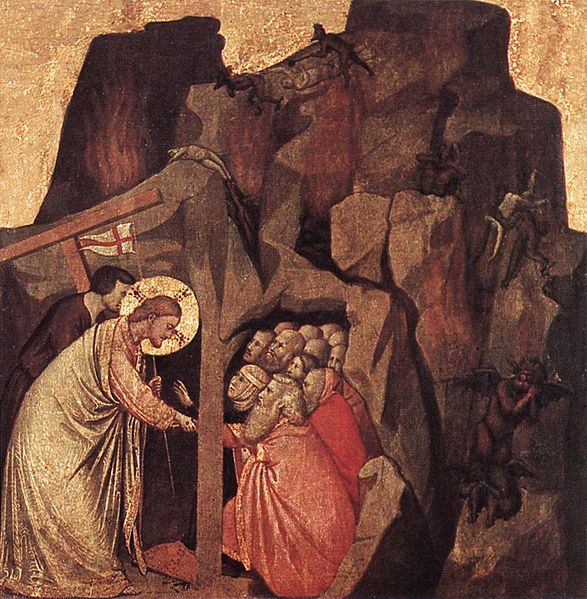
The Harrowing of Hell, Giotto, ARSH 1320. Note St. Dismas, the Good Thief, carrying the Cross. Also note the demons on the rock outcropping in the background tormenting the eternally damned, that is, those who died in mortal sin.
[Remember, the Jews were proxies for all of humanity, including you and me, and with every sin we commit, we too are Christ-killers. We should see ourselves in the baying crowd… and then repent and go to confession, and be washed in the Blood of the Lamb. Would that every Jew today would be converted to Christ and enter the Holy Catholic Church, outside of which there is no salvation. —AB ‘26]
Office of Tenebrae, Good Friday, Reading 6
From the Treatise of St. Augustine, Bishop of Hippo, Upon the Psalms On Psalm 63:
They whetted their tongue like a sword. The Jews cannot say: We did not murder Christ, albeit they gave Him over to Pilate His judge, that they themselves might seem free of His death. For when Pilate said unto them, Take ye Him: and kill Him, they answered, It is not lawful for us to put any man to death. They could throw the blame of their sin upon a human judge: but did they deceive God, the Great Judge? In that which Pilate did, he was their accomplice, but in comparison with them, he had far the lesser sin. John xix. 11. Pilate strove as far as he could, to deliver Him out of their hands; for the which reason also he scourged Him, John xix. 1, and brought Him forth to them. He scourged not the Lord for cruelty’s sake, but in the hope that; he might so slake their wild thirst for blood: that, perchance, even they might be touched with compassion, and cease to lust for His death, when they saw What He was after the flagellation. Even this effort he made! But when Pilate saw that he could not prevail, but that rather a tumult was made, Matth. xxvii. 24, ye know how that he took water, and washed his hands before the multitude, saying: I am innocent of the blood of this Just Person. And yet he delivered Him to be crucified! But if he were guilty who did it against his will, were they innocent; who goaded him on to it? No. Pilate gave sentence against Him. and commanded Him to be crucified. But ye, O ye Jews, ye also are His murderers! Wherewith? With your tongue, whetted like a sword. And when? But when ye cried, Crucify Him! Crucify Him! Mark xv.13-14
Tenebrae is the liturgical highlight of my year, and every year something jumps off the page at me. This year for Tenebrae of Good Friday in the pre-dawn hours of the morning, it was the Responsory after the Third Lesson of the First Nocturn:
I had planted thee a noble vineyard;
* How then art thou turned into a degenerate plant, which willest that Barabbas should be released unto thee, and that I should be crucified.
℣. I fenced thee, and gathered out the stones from thee, and built a tower in the midst of the land.
A degenerate plant we are indeed. And this leads into a repost by request of the reminder about what the name “Barabbas” means…
So one of my absolute favorite, make-the-hair-on-my-arms-stand-up dynamics is when God, in His perfect and unsearchable Providence, causes even His enemies to testify, unknowingly but unmistakably, to His Godhead and His infinite love. For me, these episodes are even more compelling and convincing than levitating saints (St. Philip Neri, my direct patron, for example).
This tidbit comes fromDr. Mazza’sChurch History Course. This is something that I feel like I SHOULD have known, but when Dr. Mazza said it, I was so shocked and overjoyed that I think there is no way I could have forgotten something so cool.
Let’s go back to Pontius Pilate’s court. Pilate knows Our Lord is innocent and doesNOTwant to execute Him, but the Jews, led by the High Priest and the Sanhedrin have threatened Pilate – they have threatened his life, and almost no one today understands this. Pilate was terrified for his life and the life of his family, which Mel Gibson alluded to in “The Passion of The Christ” in the scene between Pilate and his wife, Claudia, in which Pilate expresses the pressure he is under from Rome. But even Gibson’s treatment doesn’t fully explain how deep Pilate’s fear was.
Did you know that there was a man namedLucius AeliusSejanus, who was the head of the Praetorian Guard, and was essentially the number 2 to Tiberius Caesar? When Tiberius withdrew to the Isle of Capri in ARSH 26 (some of you may have been to Capri as tourists, apparently it is very beautiful), Sejanus was left to essentially administer the entire Roman Empire. Sejanus, not Tiberius Caesar, APPOINTED PONTIUS PILATE the governor of Judea. SoPilate was Sejanus’ boy, not Tiberius’. Sejanus was executed by Tiberius in AD 31 because pretty much everyone suspected Sejanus of plotting to take over. SO, when the Jews, led by the High Priest and Sanhedrin in Pilate’s Court yelled out to Pilate…
“If thou release this man,thou art not Caesar’s friend.For whosoever maketh himself a king, speaketh against Caesar.” — John 19: 12
…what they were doing was threatening Pilate’s life – they were threatening to have Pilate and his entire family “canceled” and “Arkancided” by denouncing him as not loyal to Tiberius, and rather loyal to the Sejanus faction. “Not Caesar’s friend,” but rather “Sejanus’ friend.” Which would have meant torture and execution for Pilate, and his family.
Isn’t. That. Interesting.
Plus ça change, plus c’est la même chose, non?
And just so we’re clear, as we heard in the Sixth Lesson of Tenebrae of Thursday night-Friday morning, St. Augustine says that Pilate, even under intense coercion of his own torture and death and that of his family is still guilty, but less so than the Jews. Yes, succumbing to coercion, even the most severe coercion, does not absolve guilt. WE MUST DO THE RIGHT, NO MATTER THE COST.
“By the very fact of doing what he did, Pilate became a sharer in their crime; but compared with them he was much less guilty.”
But Pilate was still guilty. Because “much less guilty” is still guilty. WE are called by Our Lord to “be perfect”, that is, to not succumb to coercion AT ALL. It’s not okay to fold in fear, find an easy way out, and wash your hands of the mess, being content with being merely “much less guilty.” Pontius Pilate is NOT a moral example to anyone. In fact, he is a dire warning against the temptation to succumbing to coercion.
NOW, for the amazing part.
Pilate, as we all know, NOT wanting to execute an innocent man, but desperate (and now we know exactly why) to appease the Jews led by the High Priest and the Sanhedrin, tried to appeal to the annual “release one prisoner” Jewish tradition. And we all know the prisoner that was offered was Barabbas. And as we all know, the Jews, led by the High Priest and the Sanhedrin cried out: “Give us Barabbas!”
STOP. Do you know what the name BARABBAS means? I’m ashamed for not making this connection. Dr. Mazza laid this out for us:
“BAR” means “the son of” in Aramaic. As in Peter’s original name being “Simon Bar-Jonah” – Simon the son of Jonah. “Blessed are you, Simon Bar-Jonah!” Matthew 16: 17. The Apostle Bartholomew is “the son of Timothy”, Bar-Timaeus.
And we should know what the Aramaic word “Abba” means from Our Lord’s words in the throes of His Agony in the Garden: “And He saith:Abba, Father, all things are possible to Thee: remove this chalice from Me; but not what I will, but what Thou wilt.” –Mark 14: 36
“Abba” means “father”.
So the criminal Barabbas’ name literally means “Son of the Father”.
So Our Blessed Lord, standing beside Pilate on the loggia of Pilate’s palace, looked down into the packed courtyard, upon Israel, the historical proxy for mankind, led by the High Priest of the Temple, and they shouted with murderous hatred and narcissistic rage:
“GIVE US THE SON OF THE FATHER!”
And then…
“LET HIS BLOOD BE UPON US AND UPON OUR CHILDREN!”
And Our Lord, infinite power, infinite LOVE, infinite mercy, said…
Amen. So be it.
And so it was, and so it is. And so we ARE redeemed, and so we might be saved.
God is so powerful that His Providence causes even His most intransigent enemies to unwittingly testify to His Godhead, and His Sacrificial Love.
(And we worry about the likes of Antipope Bergoglio and his Antichurch, or the New World Order, or the Deep State in Washington…?)
This moment is made manifest at EVERY Mass, because the Mass is the bending of space-time behind a supernatural veil such that the once-and-for-all sacrifice of Our Lord’s Passion is made literally present upon the altar. This moment in which the the entire Church cries out, “GIVE US THE SON OF THE FATHER! LET HIS BLOOD BE UPON US AND UPON OUR CHILDREN!” occurs at the elevation of the Chalice. Angels come and dip supernatural hyssop branches into the Precious Blood in the Chalice and sprinkle the world, and the Poor Souls in Purgatory, AND YOU, with Our Lord’s Blood, the Blood of the Lamb.
Now you know why Ipreferto be in the front row at Mass. Maximum angelic sprinklage. I’m only about 30% kidding. At every elevation of the Chalice, I now say inaudibly, “Give us the Son of the Father. Let His Blood be upon us and upon our children!” I have said “Let His Blood…” for many years, after a conference in Denver in which the visions of St. Gaspar del Bufalo were shared. But now I complete the moment with, “GIVE US THE SON OF THE FATHER!”
And THIS, friends, is why we GO TO MASS. We go to Mass because Our Lord stood at the top of Pilate’s steps and fallen man (which is me) begged for Him and His Blood – not even knowing what they were actually saying or doing. But Our Lord knew, and knew what Love demanded, and what we all need and want: HIM. Our Lord knew why He created mankind, and the entire universe for man, in the first place. And Our Lord in His Providence even had the infinite Mercy to arrange for fallen man, “THE DEGENERATE PLANT”, mired in sin and consumed with hatred for Him, to testify to His Divinity and the Power and Glory of His Blood.
And Our Lord said, “Amen.” So be it.
If you aren’t teared up, you should be.
Here is Gibson’s version of the incident. This clip is good because there are no subtitles. Now that you know exactly what was going on, and EXACTLY what was being said and by whom, it is far more powerful without the subtitles. And consider – Our Lady, there present in the courtyard with St. John, certainly “got” what was being said, and St. John very probably understood too.
And now, so do you. (Thanks, Dr. Mazza.)
“GIVE US THE SON OF THE FATHER!”
As always, I hope and pray this helps. Even just one person.
A longtime reader emailed in asking that one and all be reminded of the events recorded in the twentieth chapter of St. John’s Gospel. If any of you readers out there are “Extraordinary Ministers of Holy Communion” in the Novus Ordo, you really, really need to stop. Immediately.
As I have recounted on the Barnhardt Podcast, in my first year after being received into the Church (Novus Ordo), I did prison ministry at the Arapahoe County Jail. It was all laypeople. Not even the “permanent” deacons went. And, to my abject horror in retrospect, we were enjoined to perform “Catholic Communion Services” using a script authored by the not-very-conservative “conservative” Archbishop Charles Chaput, who it also turned out was rabidly anti-traditional liturgically. The “team leader” for the day would pass out, completely casually in the visitors locker room of the jail, The Blessed Sacrament to each team going to one of the six cellblocks. “How many do you want? Six? Okay. Here.” I think back on that and cringe. More than once I was handed a pyx filled with Hosts, which I then PUT IN MY POCKET and carried down to the cellblock. The only thing I can say in my own defense is that as I was walking down to the cellblock, I would “talk” to Our Lord, generally remarking to Him that He was the Creator and Sustainer of the Universe, Infinite Love and Power Himself, and… He was in my pocket. At least I acknowledged Him, and the situation, which is more than could be said for most. But it was still so totally, horrifically wrong.
Since I could speak a little Spanish, I was almost always sent to the Spanish-speaking cellblock, and most of the men who came to the “Communion Service” were either maximum security or super-max, that is, wearing either orange or red jumpsuits. Was I ever scared? No way. I was safe as a kitten. I had 15 or more exceptionally capable bodyguards at all times. The men were mostly Mexican, with some Central Americans. And I learned two very important lessons about Eucharistic piety from those men. First, many of them did not receive Holy Communion. Why? Because they had, in their words, “two wives”. That is, they were divorced and civilly “re-married”, or divorced and shacking up with another woman. They KNEW this meant that they could not receive – but they still came. The other thing I learned from the Latino felons in the jail was pre-conciliar Eucharistic piety. When they walked into the room, and saw the pyx containing the Blessed Sacrament on the table, they would immediately fall to their knees and reverence Our Lord. They believed in the Real Presence of Jesus Christ in the Eucharist. Far, far more than the upper-middle class American Novus Ordoists.
The Fruit of the First Sorrowful Mystery, Our Lord’s Agony in the Garden, is SORROW FOR SIN. Oftentimes poorly formed priests tell people that once they have confessed a sin, they should never think about it again. This is wrong. As one progresses and tries to advance in sanctity, one of the graces that follows is realizing not only what sins one has committed in the past, but realizing WHY those sins were sins, and just how awful they were. So, not only did I confess my participation in these “Catholic Communion Services” and the intrinsic sacrilege of them and of my physical handling of the Blessed Sacrament, but I also always mention these sins when I make a General Confession. Thank God! Thank God that now I not only know, but that the horror of it gets continually stronger.Let this process of realizing the kind and gravity of my sins never cease!
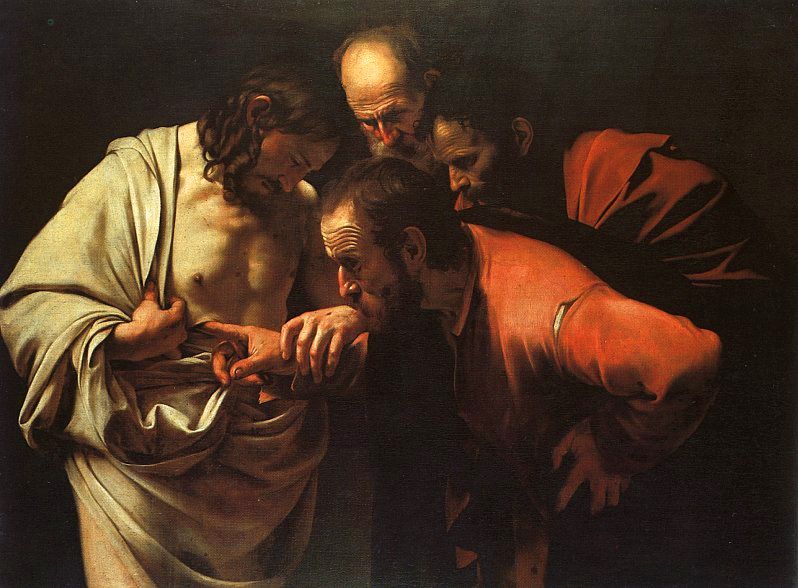
Which brings us to the whole question of physically touching the Blessed Sacrament. It is all in John 20. Our Resurrected Lord tells Mary Magdalene that SHE MAY NOT TOUCH HIM (verse 17), but just a few verses later specifically tells St. Thomas to stick his finger in Our Lord’s side (verse 27). What is the difference?
St. Thomas, having been present at The Last Supper which was not only about the institution of the Mass and the Eucharist, but also about theINSTITUTION OF THE PRIESTHOOD (“Do this in memory of Me” – only ordained PRIESTS can “do this”, that is, confect the Eucharist), was already an ordained priest. The Sacramentally Ordained may touch the Blessed Sacrament (Deacons, Priests, Bishops). Anyone else, male or female, may NOT. Period. In fact, the non-ordained may not even touch a vessel holding the Eucharist. Lay people may not TOUCH a ciborium, a chalice, a pyx, or a monstrance with bare hands, and preferably not at all. The pyx that I was given in ARSH 2007 when I began doing prison ministry, I later wrapped in a linen handkerchief and surrendered to a Traditional priest, because a vessel that held the Lord should not be sitting on a shelf in my house, and I should not even be touching it. Now, the only vessels that have contained The Eucharistic Lord in my house are ME and MY GUESTS.
It isn’t a question of contrition. The Penitent Magdalen was more contrite than any of us will probably ever be for our sins. St. Thomas was in a state of extreme and even obstinate doubt until the moment he physically touched Our Lord. It is a question of the supernatural reality of the priesthood, and of the supernatural reality of the consecration of the Eucharist within the Mass, and the Real, Physical, Substantial Presence of Our Lord in the Blessed Sacrament.
Having unconsecrated hands touch the Blessed Sacrament is a direct attack upon the priesthood, and the Eucharist itself. It is a premeditated introduction of scandalous desacralization – the modern buzzword here is “DEMYTHOLOGIZATION“.
If you are NOT a Deacon, Priest or Bishop, STOP TOUCHING THE BLESSED SACRAMENT. Only receive Holy Communion from the hands of a Deacon, Priest or Bishop, and do so kneeling and on the tongue. Do not participate in the Freemasonic scandal of desacralization, the attack on the Priesthood, the Church and the Eucharist, which is what the whole “ExtraordinaryMonstersMinisters of Holy Communion” thing is. Believe me, you will be glad you did, and you will regret not having done so sooner.
Today is Spy Wednesday, so called because this is the day in which Antipope Bergoglio’s homoerotic demoniacal patron, Judas Iscariot snuck off to the Sanhedrin to negotiate the price and seal the deal to betray Jesus Christ to be murdered.
Oftentimes in art, Judas Iscariot is depicted as ugly, almost to the point of physical deformity, with a super-heavy brow, beady eyes, etc. While one can certainly understand this iconographical approach, I think in these dark days it is more salutary for us to look upon Judas Iscariot as he almost certainly was – a perfectly normal-looking man. Folks, evil people in this world don’t walk the streets drooling, with teeth filed to points. It is generally difficult to pick out most evil people by sight. The Victoria Nulands of the world are the exception, not the norm. In fact, as I think more and more people are waking up to the fact, evil oftentimes presents itself as completely pedestrian, and not uncommonly as attractive.
Consider the fact that at the Last Supper, the Apostles had no idea which one of them would betray Our Lord. It isn’t as if Our Lord spoke of the betrayer, and everyone in the room turned and looked at Judas Iscariot. In fact, St. John says in his Gospel that even when Judas got up to leave after Jesus said to him, “That which thou dost, do quickly,” most of the Apostles thought that Our Lord had sent Judas out to either buy supplies, or to do some work of charity.
I’d like to take it a step further and put forth the possibility that when all is revealed at the General Judgment and we are all able to see EVERYTHING, that it is possible that Judas Iscariot will have appeared to have been both pious and humanly attractive. Further, I think that it is very possible that when we see all of Judas’ interactions with Our Lord, including private interactions, conversations, etc., over the course of Our Lord’s ministry and Judas’ time with Him as an Apostle, AND Judas’ interactions and relationship with the Blessed Mother (have you ever considered Judas with regards to Mary?) that it will become clear just exactly how deep and profound Judas’ betrayal was. Because remember, Judas didn’t merely walk away. Judas sold Our Lord TO BE MURDERED with full malice aforethought for today’s equivalent of approximately $800.
Why? Two things. First, as we see all around us today, Judas lusted after power. Second, Judas was EMBARRASSED by Our Lord. This all came to a head when Our Lord gave the Bread of Life discourse as recorded in John 6, explaining the Eucharist, and that He was about to institute the Eucharist whereby people would literally – not symbolically, not figuratively, but LITERALLY – eat Our Lord’s Body, Blood Soul and Divinity. Judas lusted for earthly temporal power, and had all kinds of visions and plans for Jesus overthrowing the Roman occupation and that he, Judas would be made a prince of the land, with all the power that goes with it. When Our Lord gave the Bread of Life discourse and all of the thousands of people got up and left, saying that Our Lord was insane and/or demonic, and Judas saw his planned power base and political ambitions going up in smoke, he was enraged. He was further, and perhaps even more enraged because he was EMBARRASSED by the Eucharist, as so very, very many people – most especially clerics and prelates – are today. I cover this in the essay, “THEY DON”T ACTUALLY BELIEVE ANY OF THAT BULL****.
So, still lusting after power, Judas decided that the thing to do was to get Jesus out of the way, which is to say dead, and then walk back and totally eliminate all of Jesus’ crazy-pants talk, especially the insane parts about the Eucharist, and then he, Judas, could “re-found” the movement and be its glorious leader.
By the way, is this ringing any bells? Sounding familiar at all?
Let me help you – remember that Judas Iscariot was always going on about “the poor” because he kept the money box, and was a money-grubbing thief.
Antipope Bergoglio stopped saying Mass YEARS before he died. Is anyone here surprised? Why would an apostate sodomite Antipope continue to say Mass if he could get out of doing it?
And so, Judas decided that Jesus had to be eliminated. Filled with rage and spite from the embarrassment of the Eucharistic discourse, Judas went to the Sanhedrin and negotiated the price and terms. Judas’ priority clearly was NOT getting rich off the Sanhedrin deal. No, he was playing long ball. He just wanted Jesus dead, and then the REAL MONEY would come flowing in. So, Judas low-balled the offer – $800. The Sanhedrin took the offer and the deal was sealed.
Which brings us to today. Do you want to get an idea of how normal Judas looked, how benign, how pious, even? Well, that’s easy. Go look in the mirror. Every time we sin, we are selling Jesus Christ unto death on the Cross, and selling Him cheap. What is your price? What is my price?
Is it your salary?
Your pension?
Is it your estate?
Is it your planned future earnings as you slither up the ladder of “career advancement”?
Or is it even cheaper than that? Is your price mere human respect and personal popularity?
Is your price hits on your website? Or likes on Facebook? How about clicks on your “Donate” button?
Is your price an orgasm, or several decades of orgasms?
Is your price as low as not having to actually get dressed and do anything?
As with Judas Iscariot, it is so very simple to undo our treasons against Christ – go to Him, confess and repent. In fact, Judas did return the $800 to the Sanhedrin – that part was done. How many people today refuse to do even that, or are choosing to believe the transparent lies from on high that their sins aren’t sins if they themselves “discern” that they aren’t, or worse yet, that God positively wills that they continue in their sins?
Judas knew and fully acknowledged that what he had done was wrong. All Judas had to do from there was go to Our Lord and ask His forgiveness and mercy, and it would have come without hesitation. All he had to do was get within shouting distance, which he could have. Judas could have literally gone to Calvary and been absolved by Christ as He hung on the Cross. The greatest sin ever committed, deicide, could have been wiped away, and Judas could have gone on to be a saint and the ultimate example of the penitent and forgiven sinner, the ultimate example of Christ’s mercy, far beyond Mary Magdalen.
But no. Judas murdered himself, and thus freely, and completely unnecessarily chose hell.
We’ve all sold Our Lord, and for far less than Judas’ piddly $800. We can all see ourselves in Judas. Is it not time to take our “$800” and throw it back at the Sanhedrin, and then sprint to the foot of the Cross, confess to Him, and receive His Mercy? If not now, when?
I hope this helps.
Christ, have mercy on us.
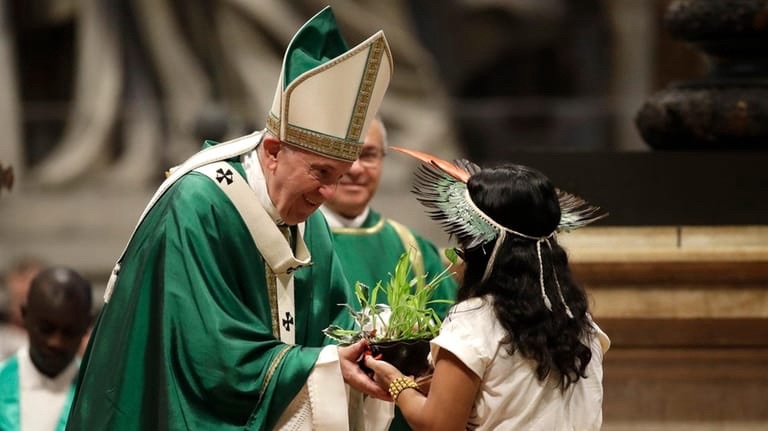
What does a person who has sold Christ cheap unto death on the Cross look like? Here’s an excellent example. And she seems so nice…. Some might even say mildly attractive. Ah, the mystery of iniquity.
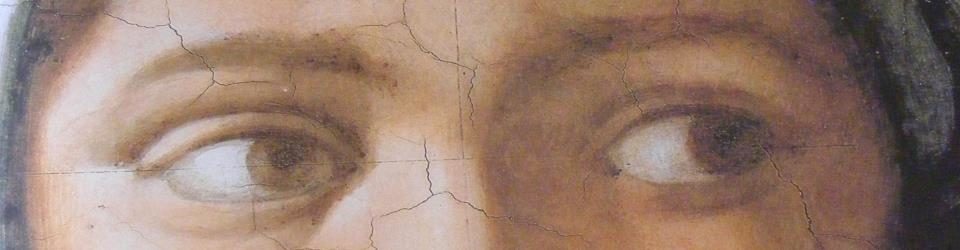

 Laypeople.
 Ordained.