Q: Ann, how can it be said that God loves us infinitely when He never speaks to us directly or shows Himself to us directly?
A: Great question, and sadly, one that is inevitably cropping up as the long-prophesied mass apostasy in the Church comes to full stinking flower, and most especially as the scandal of the Bergoglian and now PERVostian Antipapacies drive those who refuse to acknowledge that Pope Benedict Ratzinger never validly resigned into raging interior contortions of perverse and luciferian anti-logic, alliance with the satanic-Freemasonic agenda of tearing down the Office of the Vicar of Christ, and hatred of God Himself for “breaking His promises”, or whatever the blasphemous rant of the day is.
The problem, as always, is a failure to have a personal relationship with Jesus Christ. When people fail to relate to the Triune Godhead and most readily the Second Person of the Godhead, Our Lord and Savior Jesus Christ, incarnate as True God and True Man as He is, as a Divine Person, but rather as a mascot of an institution, a philosophical system, and/or a codex of laws, bad things can and usually do happen.
When you love someone (and here is where having been in love and/or having children comes in VERY handy, and where narcissists are left totally crippled and unable to comprehend the following) you want to know everything about them. St. Thomas Aquinas tells us that in order to love someone or something, one must first APPREHEND the beloved with the intellect. And the more one intellectually apprehends the beloved, the more one loves him/her/it and wants to learn MORE, and thus love becomes a positive feedback loop. This is why we often see elderly people say of their spouse, “I love her more today at age 90 than the day we were married seventy years ago.” The superficial modern mind thinks this a lie – how could somebody love the 90 year old version of their spouse more than the 20 year old version? It is because the spouses have had seventy years to intellectually apprehend each other, and the more they learned, including the ways that their spouse has dealt with the joys and trials of life and old age, the deeper the knowledge of the other, the more they loved the other. The initial rush of love at age twenty, largely focused at the beginning on physical beauty (and that is not an altogether bad thing), becomes more profound, nuanced and full even as the body degrades such that the senescence of aging is more than offset by the ascent of love rooted in the unending process of simply asking the question of the beloved: WHO ARE YOU? TELL ME, SHOW ME WHO YOU ARE.
This same dynamic should happen with well-raised children. While new parents often report “falling in love at first sight” with their newborn children, this dynamic of pining to know WHO THIS LITTLE PERSON IS, longing to see them grow into adults, longing to learn their character and personality, and thus the horrible and unnatural pain when parents outlive their children and that process of learning WHO THE CHILD IS is interrupted, all points to the universal dynamic of loving.
Given this, when we love God we are called to consciously ask exactly the same questions of Him that we would ask of our spouse or child or any object of our love: WHO ARE YOU? This is what I am talking about when I use the phrase co-opted by Protestants in the 20th century – “a personal relationship with Jesus Christ”. You can’t love Him, at least not very much, if it never occurs to you to sit down and think about WHO HE IS. If you do this, all kinds of questions will be answered. And one of those questions is: Why doesn’t He just appear and speak directly to us?
The reason why God does not generally manifest Himself (the technical term for God manifesting Himself is “THEOPHANY”) is because there can never, ever, ever be any COERCION where love is involved. Coercion instantly eliminates love. Where coercion is present, love is absent. If God were to manifest Himself to us directly, we would not have the full freedom to CHOOSE to love Him. We would be so frightened, dazzled, awestruck, completely overloaded in every sense that there would be no choice. And where there is no CHOICE, there is no LOVE.
This is what happened with the fall of one-third of the angels. God created all of the angelic beings, and before any were given the Beatific Vision Itself, they were given knowledge of God and of Creation, and the choice to serve, or not serve. Lucifer, enraged that he would not be the vector by which the Second Person of the Trinity incarnated as man (yes, Lucifer wanted the role of the Blessed Virgin Mary), declared that he would not serve, and that he would rather rule in hell than be subjugated to Mary as Mother of God, Co-Redemptrix, Mediatrix of All Graces, and Queen of Heaven and Earth. And he took one third of the angels with him. Had Lucifer and the angels been given the Beatific Vision from the moment of their creation, they would have had no choice, because it is not possible for any creature to turn away from the Beatific Vision once inside It. No choice means, essentially, coercion. And coercion means the absence of love. And so we run up against an example of the Law of Non-contradiction, which God Himself is bound to by His own existential nature.
Now to humanity – to you and me and everyone else. Imagine, in whatever crippling way possible, what it is like to be God, interacting with us. Imagine the position He is in. He loves us as much as finite beings that we are can be loved. But He is Himself… Infinite. Infinite Power. Infinite Beauty. Infinite Justice. Infinite Rationality. Infinite Love. He made and sustains the entire universe for us to exist in so that we may love Him, but BY DEFINITION we cannot be coerced into loving Him in any way. But He is Infinite.
Now just stop and THINK about this. Imagine if you were presented with an amoeba, and you loved this amoeba with all your being, and you wanted the amoeba to love you, but you CANNOT COERCE the amoeba in ANY WAY. You provide everything for the amoeba, but the amoeba can never directly see you doing it, because then the amoeba would be coerced. The only way the amoeba can love you is by coming to the realization that you not only exist, but that you also love the amoeba, by its own freely-chosen intellectual apprehension of the fact. This example is spectacularly flawed in nearly every sense, obviously, not the least of which is the fact that the existential gulf between God and Man is infinite, whereas the existential gulf between a man and an amoeba is finite and somewhat graspable.
This is why God, generally, does not directly manifest Himself to people. Because there can be absolutely no coercion. This is why we don’t hear His literal voice, but rather experience what can only be described as “the gentle whisper, the small, still voice” in prayer. This is why the Divine Providence operates in such a way that it is possible for people to mistake it for “luck” or “random chance”. This is why the Real Physical, Substantial Eucharistic Presence of God is said to be “behind the veil of friendship”, and why Christ forgives our sins in the confessional through a human proxy – His priest. It is odd to consider, but isn’t it actually easier for us to make a good confession knowing that the man on the other side of the grate isn’t the Infinite Creator and Sustainer of the Universe Himself directly manifesting Himself, but rather a proxy vector through which the Infinite Creator and Sustainer of the Universe operates so that we can not die of fright while confessing our sins? Having a heart attack or being otherwise paralyzed with fear or sensory overload tends to markedly reduce the quality of one’s Confession and/or one’s Sacramental Communion. Markedly.
There have been examples of Divine Manifestations, Theophanies, to human beings who actually did see and converse with God. I’m thinking of Saints Catherine of Alexandria and Siena, who were both mystically espoused to Our Lord, and who conversed with Him, I am also thinking of St. Thomas Aquinas to whom Our Lord spoke by animating a Crucifix that St. Thomas was praying before. What these Theophanies have in common is the fact that the people to whom Our Lord manifested Himself already loved Him so much that they were not coerced by His appearance. They had reached the third and highest state of Christian perfection, the Unitive Way. They were not coerced by Our Lord’s appearance to them any more than a loving wife would be coerced when her beloved husband walked through the door.
Another aspect to contemplate is the infinite power and control required for Infinite Love to hold Himself back from lavishing us with His directly manifested love. Again, this is where the experience of having been in romantic love somewhat helps, even if the love was unrequited, and where narcissists are completely crippled out of the chute. The feeling of wanting to GIVE love to another, the longing ache of, “Please, please, just let me love you, please accept what I so desperately want to lavish you with….” Note the precision here in what we are talking about: the desire that the beloved person PERMITS US to love THEM. That is the antecedent to the love being reciprocated. It isn’t “Love me first, and then I will love you.” No, true, healthy love BEGINS with the donation, and hopefully develops into a freely-chosen reciprocity.
Now consider God. He looks at every one of us without exception with that, “Please, please just let Me love you, please accept what I so desperately want to lavish you with…” and it is, at least to our perception as finite humans, “infinite”. So while there exists this unfathomable outpouring of love, He HAS to hold back and constrain Himself in order to never, ever coerce us. Just sit in stillness and think about the two near-infinities in play, swirling around you every moment of your existence: God’s near-infinite love for you AND God’s near-infinite restraint in holding back so that you might, MIGHT love Him back in full freedom.
But what of hell? Our Lord’s warnings of hell, which is the state of being permanently outside the Beatific Vision, never to see God, are because most people very freely choose it. Most people freely choose their own sins, their own pride, over God. Of all of the Dogmas of the One True Faith, the one that is the most visible, the most obvious, the most undeniable is the Dogma of Original Sin. Human beings have a TENDENCY toward sin, and have to fight this tendency all day every day. We see this and know this about ourselves (to deny it is a textbook trait of Diabolical Narcissism, a MASSIVE red flag), and we do see it in others every single day. This isn’t a threat, it is an objective fact. Some people fall so far into their own sin, pride and narcissism that they actively declare war on God, declare Him to be evil, and some even become literal admirers of lucifer for having rebelled against God who “didn’t care enough about me to ever directly manifest Himself to me.” But it is precisely in this fight against concupisence that our free choice to accept God’s near-infinite love for us finite beings takes on heft and meaning – to put it mildly. We aren’t pawns on a chess board. We are sovereign beings who can freely choose to be loved and love in return the Creator and Sustainer of the Universe, Infinite Good, Infinite Beauty, Infinite Power and Infinite Love Himself. But that freedom MUST include the freedom to say, “No.” And sadly, so very, very sadly, most people ultimately do choose to say “No.” But for the ones who do choose to know, love and serve God in this world, “That eye hath not seen, nor ear heard, neither hath it entered into the heart of man, what things God hath prepared for them that love Him.”
We simply cannot even begin to understand how GOOD the Beatific Vision is. We cannot comprehend just what God wants to lavish upon us. The horror of the damned will be going to their Particular Judgment and being shown, realizing just how much they were and are loved, and just how much they FREELY REJECTED – to see that they freely rejected INFINITE LOVE HIMSELF. This is the torment of hell. KNOWING what you rejected. KNOWING the enormity of your mistake. For the Baptized this torment is magnified. To know that YOU HAD IT, but that you freely chose your sins and thus freely chose to reject God and His Infinite Love, to reject the eternal and ever-new bliss of the Beatific Vision. It is a very strange thing indeed to hate God because He DOES NOT coerce us.
Love can never be coerced. God is waiting for you to turn to Him and freely fall in love with Him, because He has been in love with you since before the Creation of the Universe. If you stop and think about just how much He has to hold Himself back with us, it can only make you love Him even more.
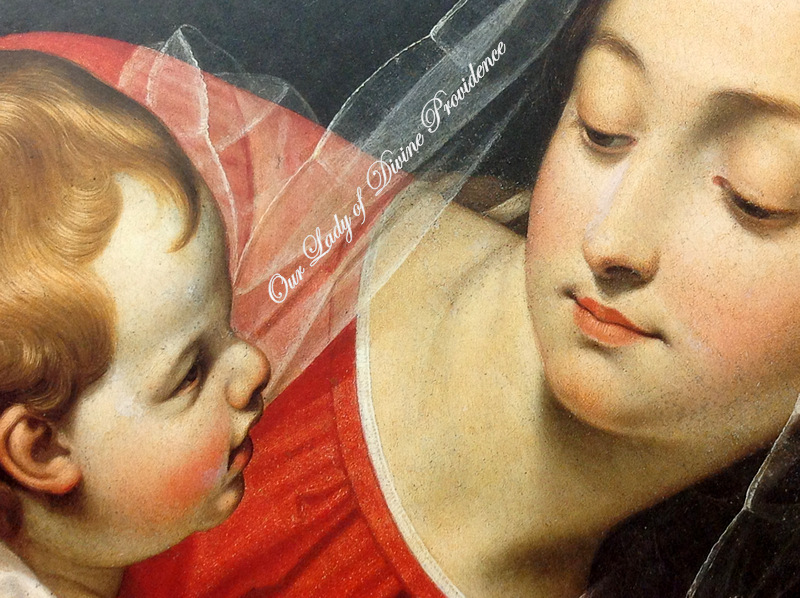
This is why St. Catherine of Siena said, “Strange that so much suffering is caused because of the misunderstandings of God’s true nature. God’s Heart is more gentle than the Virgin’s first kiss upon the Christ.”
My conclusion is this: None of us can ever possibly understand how much He loves us. And we CAN know that He loves us by simply looking up a the night sky, or thinking for a few seconds that He consciously keeps every electron in every atom of our bodies and the entire universe in its valence shell orbit. Just that is enough to know. I was given a recommendation in the Confessional years ago, that I have never stopped doing: Kneeling before Our Lord reposed in the Tabernacle or exposed in the Monstrance, say slowly, ten times, MEANING IT, “Jesus, I know that You love me.” And this isn’t “cultic” in the contemporary negative sense, because we are not talking about mere man, but of God Himself. You cannot and must not apply purely human categories and definitions to Him. You can, you MUST “throw yourself” at Him with an abandon not otherwise recommended. He wants to lavish you with love, eternally. All you have to do is say, “Yes.”
Just say yes, and “yes” on His terms. Even if that means that you won’t know the timbre of His voice saying, “I love you so much”, the sparkle in His eyes as He looks at you, the perfume of Him, the softness of His hair on the nape of His neck as you fall on Him in relief, the warmth of His chest, rising and falling with His sweet breath, the sound and gentle concussion of the beating of His Most Sacred Heart, the strength of His arms holding you up as you wilt in grateful sobs, until your earthly race is run.
Just. Say. Yes.
As always, I hope this helps.